Move Beyond AI Tools to AI Thinking
Updated: Sep 2
There is a version of AI adoption that feels productive but changes nothing structurally.

Your team uses AI to draft copy faster. Summaries get generated in seconds. Reporting takes less time. The tools are in the stack. The spend is justified. And yet, six months later, the strategy is the same, the decisions are made the same way, and the competitive position has not moved.
This is where most marketing teams are right now. Not because they lack ambition, but because there is a fundamental difference between using AI and thinking with it.
The shift from AI as a productivity layer to AI as a strategic capability does not happen automatically. It requires deliberate changes in how teams learn, how data is structured, how go-to-market decisions get made, and how organizations manage the human side of the transformation.
Here are four shifts that define what it actually looks like to move beyond tools.
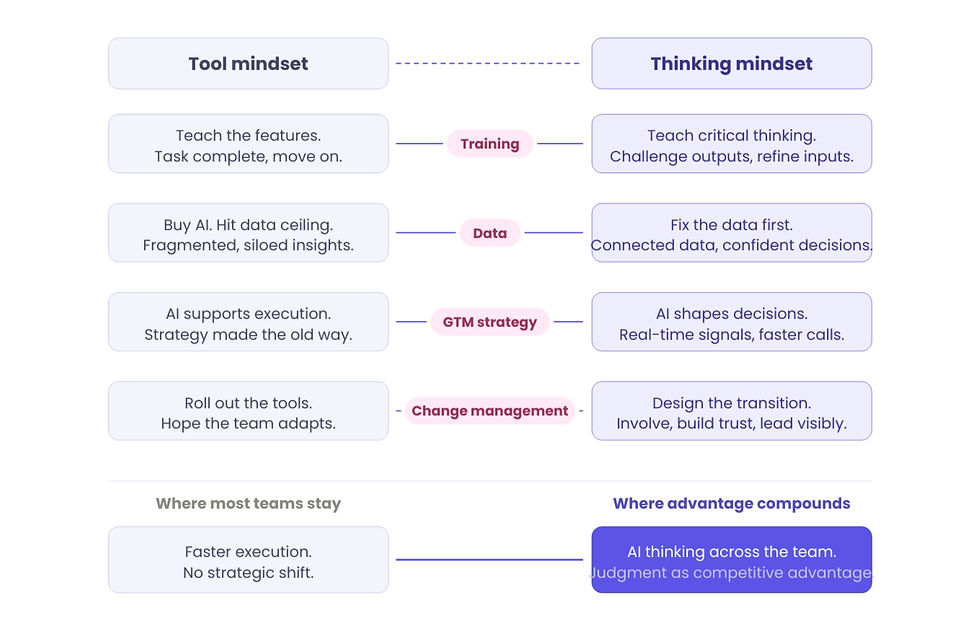
(1) How you train your team matters more than which tools you buy
Most AI training programs teach people how to use a product. Very few teach people how to think differently because of it.
The result is predictable. Marketers learn to prompt an AI tool the way they learned to use a new CMS: complete the task, move on. The tool becomes a faster version of what they were already doing. No strategic shift. No new questions being asked.
The marketers who get the most out of AI are not the ones who know the most shortcuts. They are the ones who know how to interrogate the output. They ask why conversion dropped, not just whether it did. They refine inputs based on what comes back. They use AI to surface the question underneath the question, and then they bring their own judgment to the answer.
This requires a different kind of training. Not feature walkthroughs. Intentional practice in critical thinking, output evaluation, and connecting AI-generated insight to business decisions.
AI thinking is a skill. It has to be built, not assumed.
The teams with the most AI licenses are not winning. The teams with the sharpest AI judgment are.
(2) Data readiness is the ceiling on everything else
I have seen this pattern repeatedly, both as a fractional CMO working with SaaS and technology companies and as the co-founder of an AI product: teams invest in AI capability and then discover that their data cannot support it.
When performance data lives in one platform, customer behavior in another, campaign metrics in a third, and attribution is nowhere reliable, AI cannot do what it is supposed to do. It fragments. It delivers partial answers. It generates surface-level insights that cannot be trusted enough to act on.
Clean, centralized, continuously updated data is not a technical nicety. It is the foundation that determines how much strategic value AI can actually deliver. Without it, even the most sophisticated model is just producing confident-sounding guesses.
The honest question before scaling AI investment is not "which tool should we buy next." It is: "can our current data infrastructure support what we are asking AI to do?"
For most teams, the answer requires real work. But it is the work that unlocks everything else. When data is connected across the marketing stack, AI moves from reacting to dashboards to proactively surfacing what to do next. That is when it starts earning its place as a strategic tool.
(3) AI should be shaping go-to-market strategy, not just supporting execution
There is a meaningful difference between using AI to execute a campaign and using AI to decide which campaign to run.
Most teams are still operating in execution mode. AI helps produce assets, automate workflows, and speed up reporting. It is genuinely useful there. But the strategic layer, where decisions about channels, budget allocation, messaging, and timing get made, still happens the same way it always has: in meetings, based on intuition and lagging data.
The shift worth making is toward using AI in the decision cycle itself. With the right data and the right questions, AI can tell you which campaigns are actually driving pipeline, where budget shifts will have the greatest impact, and how messaging is landing across different segments in real time, rather than three weeks after the campaign ends.
This is not about removing judgment from go-to-market decisions. It is about making better-informed judgments. The CMO's job is not to be replaced by AI analysis. It is to use AI analysis to make faster, more confident calls and to adjust strategy as conditions change, rather than waiting for the post-mortem.
The teams doing this well have moved AI into the planning process, not just the production process.
(4) Change management is what makes the other three shifts stick
This is the shift that almost no one is talking about, and it is the one I have spent the most time studying, both in my PhD research in change management and in the practical work of helping organizations navigate AI transformation.
You can have the best training program, clean data, and a clear AI strategy. If the organizational culture has not shifted to support them, the tools will be underused, the insights will be ignored, and the team will quietly revert to what feels familiar.
This is not a resistance problem. It is a design problem.
When technology moves faster than the people using it, an organization accumulates what I call cultural debt: invisible friction between the speed of the tool and the readiness of the team. It shows up as shadow AI usage, where people use tools privately because they fear judgment. It shows up as inconsistent adoption: some team members are thriving, while others feel left behind. It shows up as leaders who believe they are further along than their teams actually are.
The answer is not more pressure to adopt. It is intentional change management, running alongside the AI implementation from day one.
That means involving the team in the transition rather than announcing it. It means building psychological safety around experimentation and failure. It means framing AI not as a threat to roles but as a shift in where human contribution matters most. And it means leadership modeling the behavior it expects: using AI visibly, sharing what works and what does not, and being honest about the learning curve.
AI strategy has become people strategy. The organizations that understand this are the ones building the kind of AI readiness that actually compounds.
The difference between AI adoption and AI thinking
These four shifts are connected. Training builds the judgment to ask better questions. Data readiness makes those questions answerable. Strategic integration means the answers inform real decisions. Change management ensures the whole system holds together over time.
None of them happens by buying a new tool.
The marketing leaders pulling ahead right now are not the ones with the most AI in their stack. They are the ones who have done the organizational work to make AI genuinely useful: building capability, fixing the data foundation, integrating AI into where decisions actually get made, and managing the human transition with as much care as the technical one.
That is what moving beyond tools looks like. And it is available to any team willing to do the work.
I write about how marketing needs to change when the world around it changes, and what it takes to turn marketing into an engine for innovation and growth.
Subscribe to Marketing Rewired on Substack → for the ideas.
Explore REWIRE guides and tools → for the practical stuff.


