AI Readiness for Marketers
Updated: Sep 2
Almost every marketing team has adopted AI. Very few have mastered it. That gap, between experimenting with tools and building genuine organizational capability, is now the defining challenge for marketing leaders. And it is widening every quarter.
The pressure to adopt is real. The tools are everywhere. But having tools is not the same as being ready. Most teams are still trying to turn adoption into impact, and struggling to do it in a way that is measurable, governed, and built to last.
AI adoption is nearly universal. Strategic mastery is rare. The gap between the two is now the defining challenge for marketing leaders.
AI readiness, therefore, centers less on having tools and more on having strategy, data foundations, skills, governance, and the organizational will to scale AI responsibly across the marketing value chain.

The Adoption Illusion
When adoption rates are near-universal but only a small fraction of teams have reached true AI maturity, the data tells us something important: adoption is not the same as readiness.
Most teams are capturing the efficiency layer. Content gets produced faster. Reports are easier to compile. Tasks that used to take hours take minutes. These gains are real and worth capturing.
But they are not strategic differentiation.
The marketing leaders pulling ahead right now are doing something different. They are redesigning how their teams work, not just adding AI tools to existing workflows. They are asking different questions. Not how do we do this faster? but should we still be doing this at all, and if so, who does what?
That is a fundamentally different conversation. And it starts with readiness at the organizational level, not the tool level.
What AI Readiness Actually Means
AI readiness is not a technology audit. It is not a list of tools your team has licenses for. It is an organizational design question.
From the research I've reviewed and the work I've done directly with marketing teams, genuine AI readiness requires five things to be in place simultaneously.
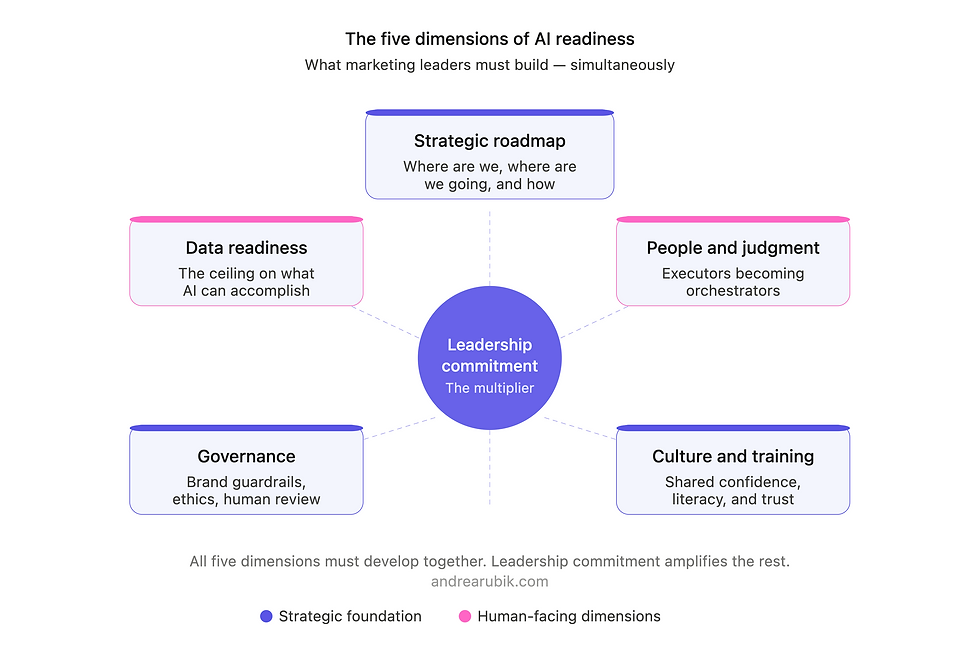
Leadership commitment that is visible and specific.
Not a slide in a company deck. Not a budget line. Actual senior-level ownership of the AI transition, with named accountability, time investment, and a willingness to model the behavior expected from the team. Research consistently shows that leadership commitment acts as a multiplier across all other dimensions of readiness. Without it, investments in data, training, and tools produce diminishing returns.
A real strategy, not a pilot mentality.
Most teams are perpetually piloting. They test a tool, it works reasonably well, and then... nothing changes structurally. AI readiness requires a roadmap: where are we now, where do we need to be, and what does the path look like across the next one to two years? Teams with an AI roadmap are significantly more likely to have training programs, governance policies, and measurable outcomes. The roadmap is not bureaucracy. It is the scaffolding that makes everything else stick.
Data that is actually usable.
AI can only be as good as the data it works with. Siloed systems, inconsistent tagging, disconnected martech stacks: these are not just operational inconveniences. They create a hard ceiling on what AI can accomplish. Before investing in more AI capability, the honest question is whether your current data infrastructure can support it.
A people strategy centered on judgment, not just skills.
The most dangerous misconception in marketing right now is that AI readiness is primarily a technical upskilling challenge. It is not. The skills that AI cannot replicate are the ones that matter most: discernment, creative vision, strategic judgment, and the ability to read context that data cannot capture. The marketers who will thrive are not the ones who know the most tools. They are the ones who know what to do with the output.
The role shift happening across every marketing function is a move from executor to orchestrator. Content marketers are becoming AI content strategists. Analysts are becoming AI-augmented interpreters. CMOs are moving from campaign oversight to operating model redesign. This is not a distant future state. It is already underway.
Governance that protects the brand.
Speed without guardrails creates brand risk. As AI increases the volume and velocity of content your team can produce, the question of what should and should not go out, and who decides, becomes more important, not less. Brand voice guidelines, human review protocols, ethics policies for AI use: these are not bureaucratic friction. They are the difference between AI as a competitive asset and AI as a liability.
The Gap Nobody Is Talking About
A perception problem sits at the heart of many marketing organizations' AI challenges.
Senior leaders consistently rate their own team's AI maturity significantly higher than the people on those teams do. This gap is not trivial. It is one of the most dangerous blind spots in AI readiness, because leaders who believe they are further along than they are invest less in the infrastructure, training, and governance that actually drives maturity.
If you are a marketing leader reading this, the most valuable thing you can do right now is not adopt one more tool. It is to sit with your team and ask honestly: what do you need to work with AI confidently, consistently, and well? Then listen carefully to the answer.
The organizations that are compounding advantage from AI right now are the ones where leadership has done exactly that: closed the perception gap, invested in real capability building, and structured the human-AI partnership deliberately rather than by default.

The Human Layer Is Not Shrinking
I want to address something directly, because it comes up in nearly every conversation I have about AI and marketing.
The human role in marketing is not diminishing. It is becoming more specific and, in many ways, more valuable.
As AI drives the marginal cost of content toward zero, volume is no longer a differentiator. What differentiates is judgment. The ability to know which ideas are worth pursuing and why. The ability to build genuine audience trust. The ability to read the room in ways no model can. The ability to make creative decisions that reflect real human understanding, not pattern matching at scale.
Brand trust, creative integrity, strategic direction, ethical judgment: these remain firmly human domains. And in a world where AI content is everywhere, the marketing teams that protect and amplify the human layer will be the ones that stand out.
This is not a comforting narrative for people who are afraid of AI. It is a strategic reality for people who are thinking clearly about where to invest their own development.
Where to Start
If you are a marketing leader assessing where your team sits on the AI readiness spectrum, here is the sequence I recommend.
Start with an honest maturity audit. Not a tool inventory. A real assessment of where your team is on the spectrum from experimentation to integration to transformation, across culture, strategy, data, governance, and talent.
Identify your highest-leverage gap. Most teams have one dimension that is limiting everything else. For many, it is the absence of a roadmap. For others, it is data quality or the absence of clear human-AI task allocation. Name it specifically.
The teams pulling ahead are not the ones with the most AI tools. They are the ones where judgment is the competitive advantage.
Build the infrastructure before scaling the tools. Training programs, governance guidelines, and clear role definitions are not overhead. They are the foundation that turns AI experimentation into a compounding advantage.
Lead visibly. Your team takes its cues from you. If you are using AI thoughtfully, sharing what you learn, and talking openly about both the possibilities and the limits, you are doing more to build organizational AI readiness than any tool implementation can.
The Work Ahead
The teams that treat it as a checklist will keep generating efficiency gains without strategic differentiation. The teams that treat it as an operating model question will build something more durable.
AI readiness is not a destination. It is an organizational capability that must be built, maintained, and evolved as technology changes.
The window to do this well is narrowing. The leaders who act with intention now, building human capability, governance, strategy, and cultural openness to change, will define the competitive landscape ahead.
That is the work. And it is worth doing.
I write about how marketing needs to change when the world around it changes, and what it takes to turn marketing into an engine for innovation and growth.
Subscribe to Marketing Rewired on Substack → for the ideas.
Explore REWIRE guides and tools → for the practical stuff.


