AI is Already Outperforming Your Best Freelancers
Updated: Sep 2
The marketing world is currently witnessing a transition as seismic as the arrival of the internet itself. We have entered the Paradigm of Generative Marketing - a shift where generative AI (Gen AI) has moved beyond the realm of futuristic experimentation to become a primary engine of economic value. Industry reports now quantify this impact at a staggering USD 463 billion in the marketing sector alone.
Early movers have already demonstrated the power of this technology, such as Heinz’s award-winning "A.I. Ketchup" campaign, which harnessed synthetic imagery to garner over 850 million earned impressions. But for the sophisticated strategist, the story isn't just about viral novelty; it is about a fundamental restructuring of the Iron Triangle of marketing: quality, cost, and speed. For decades, the assumption was that high-tier creative required human intuition and a massive budget. Recent large-scale empirical studies have shattered that assumption, revealing that in terms of objective performance, AI is already operating at superhuman levels.

#1 The Superhuman Performance Gap in the Field
The most compelling evidence of AI’s superiority comes from the field, where theoretical potential meets real-world consumer behavior. In a comprehensive field study analyzing banner ad effectiveness, researchers compared professional, human-made stock photography against images generated by state-of-the-art AI models.
The results provide a wake-up call for creative directors: banner ads generated by DALL-E 3 achieved a Click-Through Rate (CTR) of 0.80%, compared to just 0.53% for professional stock photography selected by a marketing expert. This represents a staggering increase of over 50% in engagement. This isn't just good enough content produced at scale; it is objective performance superiority. As the research concludes, the shift toward Gen AI allows firms to produce content that reaches superhuman effectiveness levels, outperforming the best-selected human benchmarks in driving consumer action.
#2 AI Hyperrealism is More Real Than Reality
One of the most psychologically significant findings in recent research concerns the Realistic Vision model. When testing seven different text-to-image models against human-made images across perceptual dimensions, Realistic Vision was the only model to actually surpass human-made photos in perceived realism.
This phenomenon, known as AI Hyperrealism, occurs because specialized AI can generate photorealistic depictions that are technically flawless, avoiding the visual noise often found in real photography. For marketers, this has profound strategic implications. Realistic product portrayals are critical because they facilitate a consumer’s mental simulation of product usage. When an image feels more "real" than reality, it bridges the gap between passive viewing and the cognitive intent to purchase more effectively.
#3 The End of the High-Cost Creative Barrier
The economic disruption of Gen AI is most visible when we look at the unit cost of content. Traditional creative workflows are labor-intensive, creating a high-cost barrier that historically limited high-frequency testing to the largest firms. AI has effectively democratized elite visual marketing by collapsing these costs:
Professional Freelancer: ~$100.00 per image
Professional Stock Photo: ~$9.00 per image
DALL-E 3: ~$0.04 per image
SDXL Turbo: ~$0.00005 per image
The math here is a mic drop for any CFO: An advertiser can create 225 high-performing images with DALL-E 3 for the price of a single professional stock photo. Even more extreme, for the cost of just one freelancer-designed asset, a firm could theoretically produce two million images using an open-source model like SDXL Turbo. This level of efficiency doesn't just save money; it enables a scale of A/B testing and personalized mass persuasion that was previously impossible.
#4 AI Out-Creates the Professional Freelancer
In a direct creative shootout, researchers issued identical creative briefings, including a task for the Red Bull "Gives You Wings" campaign, to both commissioned human freelancers and AI models.
DALL-E 3 outperformed human freelancers across five of ten critical marketing metrics, including high-value qualitative categories such as ad creativity and ad attitude.
One major reason for this superiority is what we call briefing deviation or instructional drift. In the study, human freelancers often deviated from the brief, delivering a lime-themed design when asked for mint, or an illustration when asked for a photorealistic brand selfie. In contrast, the AI followed complex prompts with significantly higher fidelity, delivering the exact flavor and style requested.
#5 The Strategic Framework: Input vs. Augmentation
Strategic implementation of Gen AI requires navigating two variables: the nature of the Input (General vs. Custom) and the level of Human Augmentation required. This creates a 4-Quadrant Organizing Framework:
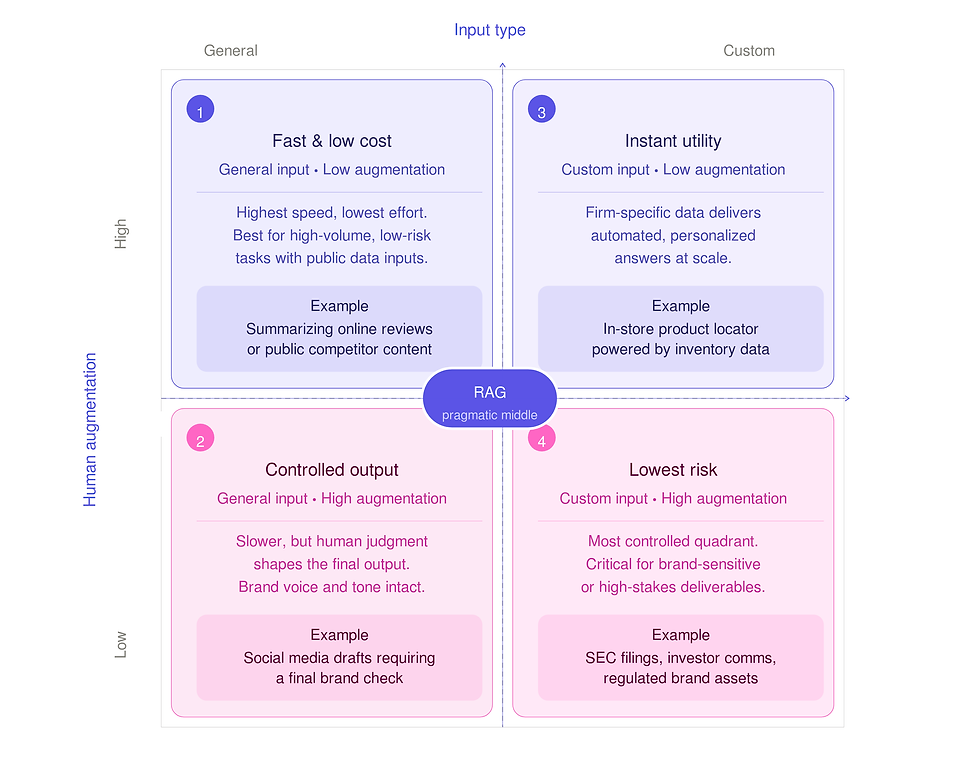
General Input / Low Augmentation: Fastest and lowest cost. Ideal for low-risk, high-volume tasks like summarizing online reviews.
General Input / High Augmentation: Slower but more controlled. Best for tasks like drafting social media posts that require a final human brand check.
Custom Input / Low Augmentation: Uses firm-specific data to provide instant, automated utility, such as an in-store product locator.
Custom Input / High Augmentation: The most controlled and least risky. Essential for brand-critical assets or high-stakes documents like SEC filings.
For most firms, the pragmatic middle ground is Retrieval-Augmented Generation (RAG). RAG allows you to tune a general model (like GPT-4) with your own curated, internal documents, essentially giving a world-class AI brain a specialized library of your brand’s proprietary knowledge.
#6 Navigating the Jagged Frontier of Risks
Despite its superhuman performance, Gen AI is not a set-and-forget solution. We are currently operating on a Jagged Frontier. This means the technology excels at extraordinarily complex tasks (such as synthesizing vast market data) but can fail at seemingly simple ones (such as correctly orienting a specific brand logo or rendering human hands).
Marketers must remain vigilant against three primary risks:
Hallucinations: The probabilistic nature of AI means it can confidently state nonsensical or factually incorrect information.
Privacy Appropriation: The risk that sensitive corporate data or PII uploaded to a general model could be "leaked" or used to train future iterations.
The Snoopy Problem: Specifically referring to Intellectual Property Rights (IPR) infringement. AI models can inadvertently replicate copyrighted characters or protected visual elements, creating massive legal exposure for firms that deploy output without human scrutiny.
The AI-in-the-Loop Future
The role of the marketer is undergoing a fundamental shift from creator to editor and orchestrator. We are moving toward AI-in-the-loop systems where generative models produce vast arrays of assets, and human experts curate them for the highest strategic impact.
The data is undeniable: AI can already produce more realistic and creative content than human professionals at a fraction of a cent. As you plan for 2025, the immediate move is clear: Conduct a creative spend audit. Identify your high-volume, low-risk assets and migrate them to AI immediately to capture ROI.
The provocative question remains: If AI can deliver superhuman performance at 1/2000th the cost of your current workflow, what unique, high-level value will your human creative team provide that can’t be replicated by a prompt?
I write about how marketing needs to change when the world around it changes, and what it takes to turn marketing into an engine for innovation and growth.
Subscribe to Marketing Rewired on Substack → for the ideas.
Explore REWIRE guides and tools → for the practical stuff.
Resources:
Wang, M., Zhang, D. J., & Zhang, H. (2026). "Large Language Models for Market Research: A Data-Augmentation Approach." Marketing Science. This paper addresses a critical academic concern: the inherent bias of using Large Language Models (LLMs) as direct substitutes for human subjects in research. The authors propose a statistical data-augmentation framework that integrates LLM-generated data with real human data in conjoint analysis. The study demonstrates that while LLMs are not a "naïve substitute," they serve as a powerful complement that can reduce estimation errors and offer cost and data savings of between 24.9% and 79.8%.
Hartmann, J., Exner, Y., & Domdey, S. (2025). "The power of generative marketing: Can generative AI create 'superhuman' visual marketing content?" International Journal of Research in Marketing. Widely cited in current literature reviews, this empirical study investigates whether generative AI can produce visual content that outperforms human creative professionals. Utilizing A/B field experiments on platforms like Meta and Google Ads, the researchers found that AI-generated images achieved significantly higher click-through rates (CTR) for certain product categories, particularly "hedonic" or lifestyle products where aesthetic perfection is highly valued.
Yoo, K., Haenlein, M., & Hewett, K. (2025). "A whole new world, a new fantastic point of view: Charting unexplored territories in consumer research with generative artificial intelligence." Journal of the Academy of Marketing Science. This paper serves as a seminal methodological "field guide" for the discipline. The authors illustrated the capabilities of Large Multimodal Models (LMMs) by attempting to replicate the various research stages—from theory development to data collection- of 35 different articles sourced from five top-tier marketing journals. Their findings identify exactly where AI excels (theoretical frameworks) and where it currently struggles (silicon sampling and complex data analysis).
Grewal, D., Satornino, C. B., Davenport, T., & Guha, A. (2025). "How generative AI is shaping the future of marketing." Journal of the Academy of Marketing Science. Published in a premier marketing journal, this conceptual framework is frequently cited for establishing the strategic "continuum" of AI implementation. The authors outline the dual strategic decisions firms must navigate: the level of input customization (ranging from general LLMs to custom-tuned Retrieval-Augmented Generation) and the degree of human augmentation required before AI content is shared with consumers. It provides a foundational roadmap for researchers studying the long-term strategic shift from analytical to generative systems.


