What Strategic Marketing Actually Means
Updated: Sep 2
Why Most Marketing Teams Are Busy for the Wrong Reasons
The biggest misconception about strategic marketing is that it is something you add once execution is running. A layer you apply on top, like polish on wood that is already cut and shaped. In reality, strategy must come first, because execution amplifies whatever direction exists. If the direction is unclear, execution scales confusion.
I have seen this pattern more times than I can count across two decades of working with companies ranging from Telenor and Direct Media to early-stage SaaS startups and AI ventures. Teams double their ad budgets, increase content output, expand their channel mix, and still see marginal growth. Not because the tactics are wrong. Because the underlying strategic question was never answered: what exactly are we trying to change in the market?
When that question is missing, marketing becomes reactive. Teams chase trends, copy competitors, and prioritize what looks impressive over what moves the business. Activity increases, dashboards fill up, and leadership still feels something is off.
That feeling is usually the absence of strategy.
The distinction is simple but consequential. Execution answers: What are we doing? Strategy answers: why are we doing it, and what will it change? Without that distinction, marketing becomes busy instead of effective. And in a world where the cost of marketing activity has never been lower and the noise has never been higher, busy is not a competitive advantage.

What strategy actually is
Strategic marketing is the discipline of deciding where to compete, who to win, what to be known for, and crucially, what not to do. It is not about doing more. It is about choosing deliberately.
Real strategy creates focus. Fake strategy creates activity.
This is harder than it sounds. In my experience working with leadership teams across Switzerland, Croatia, and internationally, the most common failure mode is not a lack of ambition or talent. It is a reluctance to make choices that close doors. Leaders want to keep options open. They add to the strategy instead of sharpening it. They say yes to one more channel, one more segment, one more campaign idea.
The result is a marketing function that is spread thin, difficult to evaluate, and impossible to hold accountable, because it was never designed around a clear set of outcomes in the first place.
Strong strategy is not about saying yes to the best option. It is about saying no to everything else, and having the conviction to maintain that no when the pressure to expand inevitably arrives.
The Strategic Marketing Operating Model
Before going into the six layers in detail, it helps to see the full system. Most teams enter this model halfway through and then wonder why results feel inconsistent.
Market Reality
↓
Business Objective
↓
Strategic Choice
↓
Positioning
↓
Execution Plan
↓
Measurement
↓
Learning Loop
The sequence is: Market Reality, then Business Objective, then Strategic Choice, then Positioning, then Execution Plan, then Measurement, then the Learning Loop that feeds back into reality.
Most teams start at execution. Strategic teams start at reality. That single difference in starting point determines whether marketing compounds over time or resets every quarter.
The 6 Layers of Strategic Marketing in Practice
1. Market Reality
Strategy begins with truth, not ambition.
Many organizations approach marketing planning as though they are designing a future they can invent, rather than navigating a market they must understand. They lead with goals and build backwards. But strategy does not start with imagination. It starts with observation.
The strongest marketing leaders I know, and the ones I try to emulate in my own practice, spend disproportionate time studying reality before planning action. They analyze buying behavior, listen to recorded sales calls, review win and loss data, study support tickets, interview customers who churned, and observe competitors closely. Not to copy them, but to understand what the market actually rewards.
Reality is rarely what internal teams assume. I have worked with companies where the product feature the team was most proud of was not the one customers cited when explaining why they bought. I have seen businesses targeting one audience while their highest-converting customers were coming from a completely different segment. I have advised companies who were convinced they were competing with one player while buyers were comparing them to someone else entirely.
Strategic marketing begins the moment assumptions are replaced with evidence. That shift is often uncomfortable. It requires admitting that the internal story and the market reality are not the same thing. But that discomfort is precisely where strategy starts to get useful.
2. Business Objective
Marketing cannot be strategic if it does not know the company's primary objective.
Growth looks different depending on what leadership is actually trying to achieve. Revenue growth, valuation growth, market share, category ownership: each requires fundamentally different marketing decisions. Different positioning, different channels, different metrics, different timing. If marketing does not know which objective matters most right now, it will try to serve all of them and succeed at none.
One of the most valuable conversations I have with founding teams and CEOs early in an engagement is a very simple one: what does winning look like in the next twelve months, and how will you know you got there? The answers are often surprising. Leadership is not always aligned. Marketing has one answer. Sales has another. The CEO has a third.
That misalignment is not a communication problem. It is a strategy problem. And no amount of campaign optimization will fix it until the destination is agreed.
Strategy clarifies the destination. Execution builds the road. You cannot build a road if no one can agree where it ends.
3. Strategic Choice
This is where real strategy happens and where most companies hesitate.
Choice forces trade-offs. Trade-offs create discomfort. Leaders often say they want focus, but when presented with concrete options, they struggle to eliminate any. They worry about missing opportunities, alienating segments, or narrowing their reach in ways they cannot recover from. So instead of choosing, they expand.
The result is diluted messaging, scattered execution, and fragmented impact. Marketing that means everything to everyone means nothing to anyone.
The paradox is simple and well-evidenced: the more focused your strategy, the more opportunities you create. Clear positioning attracts the right customers faster because they immediately recognize themselves in your message. Targeted messaging converts better because it speaks to a specific problem with a specific solution. Concentrated effort compounds because each initiative reinforces the others rather than pulling in competing directions.
I use a simple framework when working through this with leadership teams. For each strategic option on the table, I ask three questions. Who specifically does this serve? What does it require us to stop doing? What would success look like in six months? Any option that cannot answer all three clearly is not ready to be a strategic choice. It is still an idea.
4. Positioning
Positioning is not a slogan. It is a decision.
It defines who you are for, why you matter, why you are different, and why that difference is valuable to the specific person you are trying to reach. When all four of those questions are answered clearly and consistently, positioning becomes a force multiplier for everything downstream.
Positioning is often treated as a branding exercise, a creative output that the marketing team produces and the rest of the organization approves. In reality, positioning determines how you compete. It is a strategic decision that belongs in the boardroom before it belongs in the brand guidelines.
When positioning is clear, marketing becomes easier because the market already understands your value before your sales team ever speaks to them. Sales cycles shorten. Pricing pressure decreases because buyers are not defaulting to comparison on price when they cannot distinguish on value. Trust builds faster because consistency builds credibility over time.
When positioning is unclear, the entire revenue function pays a hidden tax. Marketing works harder to explain relevance. Sales teams spend time educating instead of closing. Prospects compare on price instead of impact because they have no other basis for comparison.
A test I use with leadership teams: ask everyone in the room to write down your positioning in one sentence without discussing it first. If the answers differ significantly, you do not have a messaging problem. You have a strategy problem. The messaging is just where it becomes visible.
5. Execution Plan
Only now does execution begin.
This is where channels, campaigns, content, and tactics belong. Not before. Moving execution to this position in the sequence is one of the most significant structural changes a marketing function can make, and one of the most resisted, because it requires discipline from people who are often rewarded for speed and volume of output.
Execution is where strategy becomes visible in the market. When execution is strategic, every initiative maps directly to a business objective. There is a clear line connecting budget, activity, and expected outcome. Anyone on the team should be able to answer, for any initiative they are working on, which strategic goal this serves and what success looks like.
When execution is not strategic, marketing plans look like lists rather than systems. Initiatives exist because they are trendy, because a competitor is doing them, because they were done last year, or because someone in a meeting thought they sounded good. Teams stay busy, but progress is inconsistent because efforts do not reinforce each other.
Strategic execution feels fundamentally different. It is coordinated, focused, and intentional. Instead of dozens of disconnected activities running in parallel, you see a small number of initiatives working together toward the same goal, each one building on the others. That is when marketing starts to compound instead of restarting from zero every quarter.
6. Measurement and the Learning Loop
Measurement is widely misunderstood as proof of performance. In strategic marketing, measurement is a decision tool.
The goal of tracking metrics is not to show what happened. It is to determine what should happen next. That shift in framing changes everything about what you measure, how often you review it, and what you do with the findings.
Strategic teams measure business outcomes first, then the leading indicators that predict those outcomes, then the efficiency metrics that tell them whether they are deploying resources well, and finally the behavioral signals that tell them how customers and prospects are actually moving through the system. They do not measure everything. They measure what informs decisions.
High-performing teams interpret results, look for patterns, and act on what they learn. A dashboard that does not change decisions is decoration. I have seen organizations spend significant time and budget building reporting infrastructure that no one uses to make a different call. That is not a measurement. That is comfort.
Real measurement systems create feedback loops that shorten the distance between action and insight. They allow teams to test faster, learn faster, and improve faster than competitors who are still reviewing quarterly reports after the market has already moved.
In competitive markets, learning speed is a strategic advantage. The team that can run a meaningful experiment in a week and act on the result in the same week will consistently outperform the team that takes a month to do both.
Strategic vs Tactical Thinking
The clearest way I have found to illustrate this distinction is through the questions each mode asks.
A tactical question sounds like: what should we post this week? A strategic question sounds like: what perception must change in the market for revenue to grow?
TACTICAL
“What should we post this week?”
STRATEGIC
“What perception must change in the market for revenue to grow?”
Tactics operate inside a system. Strategy designs the system. Both are necessary. Neither replaces the other. But they operate at different levels, and confusing them is one of the most expensive mistakes a marketing function can make.
I have met talented marketers who are exceptional tacticians and struggling strategists, not because they lack intelligence, but because they were never given the organizational conditions to think strategically. Leadership kept changing priorities. Goals were vague or shifting. There was no space between campaigns to ask the bigger questions.
That is a leadership problem, not a marketing problem. And it is worth naming clearly, because too often the people who are blamed for poor marketing performance are the ones executing faithfully in a direction that was never properly set.
The Real Reason Companies Struggle
Most organizations do not lack marketing talent. They lack decision clarity.
What looks like a performance problem is nearly always a leadership alignment problem underneath. Teams can only execute as well as the direction they receive. If priorities shift constantly, execution appears inconsistent. If goals are vague, results look unpredictable. If the strategy is unclear, performance seems disappointing. The diagnosis points at the team, but the cause sits higher up.
Strategic marketing requires leaders who are willing to make decisions early, communicate them with clarity and conviction, and maintain them long enough for execution to compound. This sounds straightforward. In practice, it requires resisting a steady stream of distractions, competitive reactions, internal opinions, and short-term pressures that all argue for changing course before the strategy has had time to work.
Consistency is underrated. In strategy, consistency is power. The companies I have seen build durable market positions are not necessarily the ones with the best ideas. They are the ones with the discipline to pursue a clear direction long enough for it to take hold.
How to Know Your Marketing Is Truly Strategic
There are five signs I look for when assessing whether a marketing function is operating strategically or tactically.
Strategic Marketing Mind Map
Reality
└─ Market truths
Direction
└─ Business objective
Choices
└─ Target + focus
Position
└─ Differentiation
Execution
└─ Channels + campaigns
Learning
└─ Metrics → insight → iteration
Priorities are limited and clear. Not a list of ten things, but a hierarchy of three, with the top one unambiguous. Initiatives map directly to business goals, and everyone on the team can articulate that connection. Leadership and marketing define success in the same terms, using the same metrics, with the same timeframe in mind. The team knows what not to do, and that list is as important and actively maintained as the list of what to do. And results compound over time rather than resetting each quarter, because each initiative builds on the infrastructure created by the last.
Strategy creates momentum. Tactics create spikes. The organizations I most admire have learned to distinguish between the two and build systems that favor the former.
A Test I Use with Leadership Teams
I ask one question, and I ask everyone to answer it independently before any discussion.
If marketing disappeared for 90 days, what business outcome would change first?
The quality of the answer tells me almost everything I need to know about the strategic health of the marketing function. When marketing is truly strategic, the answer is immediate, specific, and consistent across the room. People say things like: " the pipeline would drop by X, or our renewal rate would decline within 60 days, or we would lose ground in this specific category to this specific competitor.
When marketing is not operating strategically, the answers are vague or varied. People say things like: we would lose visibility, or it would probably be fine for a while. That uncertainty is not a sign that marketing is unimportant. It is a sign that its strategic role has not been clearly defined.
When marketing is strategic, its impact is obvious, measurable, and directly tied to growth. If it is not yet obvious, that is the work.
What Strategic Marketing Actually Means
The strongest marketing organizations I have worked with and within do not feel chaotic. They feel calm. Not because they are doing less, but because they are doing what matters, and they know why each thing matters.
There is a visible difference between a team executing tasks and a team executing a strategy. One looks busy. The other looks focused. One measures activity. The other measures impact. One restarts every quarter. The other builds.
Strategic marketing is ultimately a leadership discipline. It connects market reality, business objectives, positioning, and execution into a coherent system in which every element reinforces the others. It requires making uncomfortable choices, maintaining them under pressure, and building the organizational conditions in which good execution can compound over time.
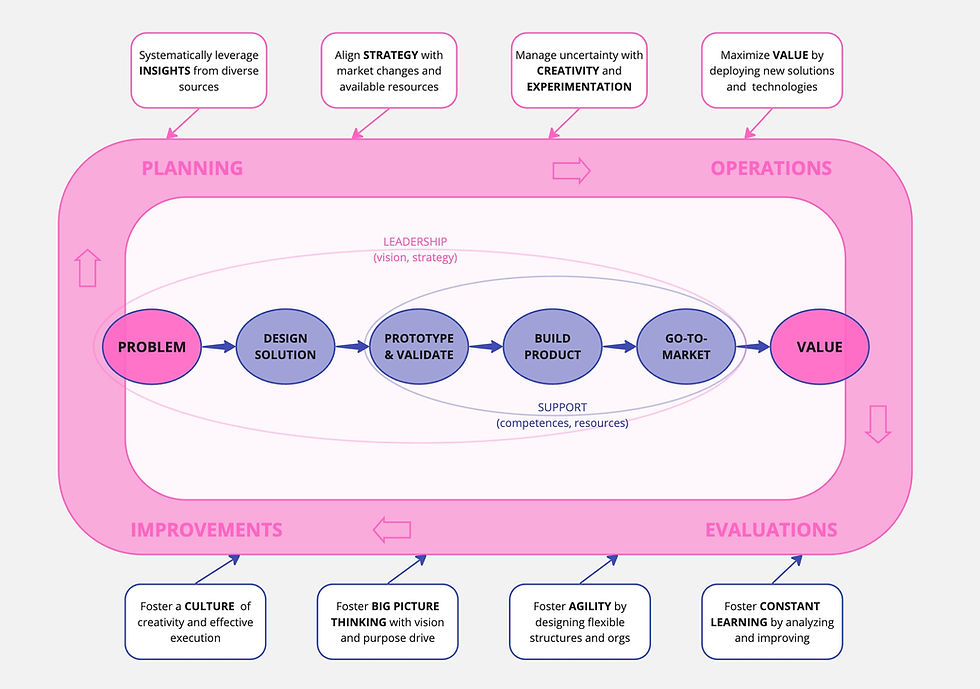
The companies that win are not the ones doing the most marketing. They are the ones doing the most aligned marketing.
Strategy is not what you plan. It is what you choose. And more importantly, it is what you protect.
I write about how marketing needs to change when the world around it changes, and what it takes to turn marketing into an engine for innovation and growth.
Subscribe to Marketing Rewired on Substack → for the ideas.
Explore REWIRE guides and tools → for the practical stuff.


